The short answer
- California's construction toilet rule requires employee facilities, with stated exceptions; portable units address sites where suitable fixed facilities cannot be provided.
- Agricultural field sanitation has separate requirements for worker access to toilets, handwashing facilities and potable drinking water.
- Outdoor heat planning includes drinking water and shade, so a restroom order needs coordination with the employer's safety plan.
Construction Toilets, Harvest Wash Water and Outdoor Shade
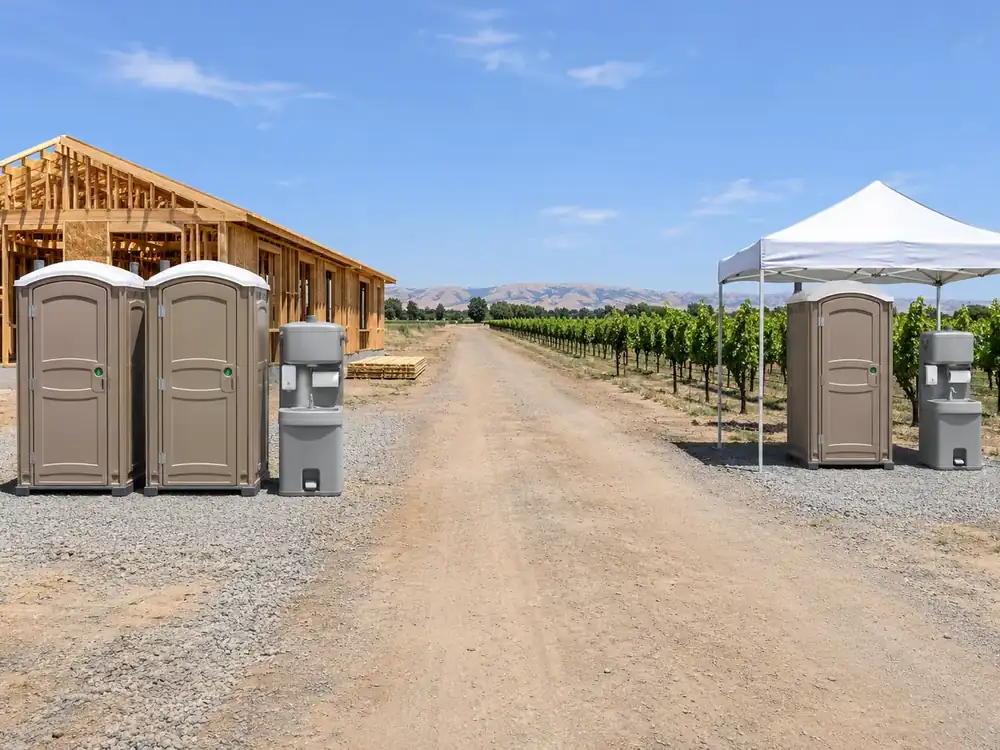
California workplace rules address employee toilets, field sanitation and protection from outdoor heat. For new-home construction, harvest work or field packing, discuss the work itself as well as the headcount. A unit order needs to fit the employer's safety arrangements and the route used for service visits.
Toilets for New-Home Construction
California's construction toilet rule calls for a separate toilet facility for each twenty employees, or fraction, of each sex, subject to its stated exceptions. Where there are fewer than five employees, a single-user facility designated for all-gender use is sufficient under the small-crew exception. Mobile crews with transportation readily available to nearby toilets have an exception under the same rule.
Describe existing restrooms and who can use them. For an addition or a new subdivision, explain changing work areas, vehicle routes and whether a toilet pad could become blocked by materials. Ask the employer's safety lead to apply the rule's exceptions to the actual work arrangement.
Harvest Rows and Field Packing
Agricultural sanitation planning depends on the operation and the workers' location. The field sanitation rule covers agricultural employers and distinguishes hand-labor operations from work in permanent packing houses.
For field sanitation toilet and hand wash rental, describe harvesting, hand packing and movement along the rows. Facilities must be close together and within a quarter-mile walk or five minutes, whichever is shorter, under the field placement requirements. Where terrain makes that infeasible, the rule places facilities at the closest point to vehicle access.
Handwashing requires potable water, soap or another suitable cleansing agent, and single-use towels under the handwashing provisions. Employers must retain written service and maintenance records for two years under the recordkeeping requirement. Discuss how service records will reach the person responsible for the site.
Portable Toilets in Summer Heat
Heat planning needs drinking water and a suitable place for recovery as well as a toilet pad. California's outdoor heat rule requires drinking water as close as practicable to work areas and sets requirements for shade and preventive cool-down rests.
For a porta potty in hot weather, discuss sun exposure, the wash-water supply and a reachable pad. Ask the safety lead how the restroom route fits the shade and drinking-water plan. A wash sink does not settle the drinking-water arrangement.
Rules to Review With the Safety Lead
The applicable rule depends on the work and the question being settled.
| Work or concern | Rule to review |
|---|---|
| Construction employee toilets | California construction toilet requirements |
| Agricultural field sanitation | California field sanitation requirements |
| Outdoor heat protections | California outdoor heat requirements |
| Federal construction sanitation | OSHA sanitation standard |
The federal OSHA construction sanitation standard addresses employee toilets, potable drinking water and washing facilities, including lavatories with running water, soap and a way to dry hands. Ask the safety lead or Cal/OSHA about applying California requirements to the job; use OSHA's published standard for federal sanitation questions.
Unit Selection and Service Access
The rental discussion still needs to settle the unit model, wash-water supply, pad and service arrangements. Explain how many people will use the facilities and how work moves through the site. Discuss service visits against expected use rather than assuming a fixed rental package.
Choose firm, level ground away from moving equipment, vehicle traffic, irrigation runoff and overhead lines. Keep the truck approach and walking route open. Never move, tip, lift or climb on a unit; contact your service pro about relocation or a service visit.
Call with your project or harvest setting. One of our local portable restroom partners will outline the unit plan and its price before the rental proceeds.